
New Amazon Data
In preparation for a new primer, coming soon...
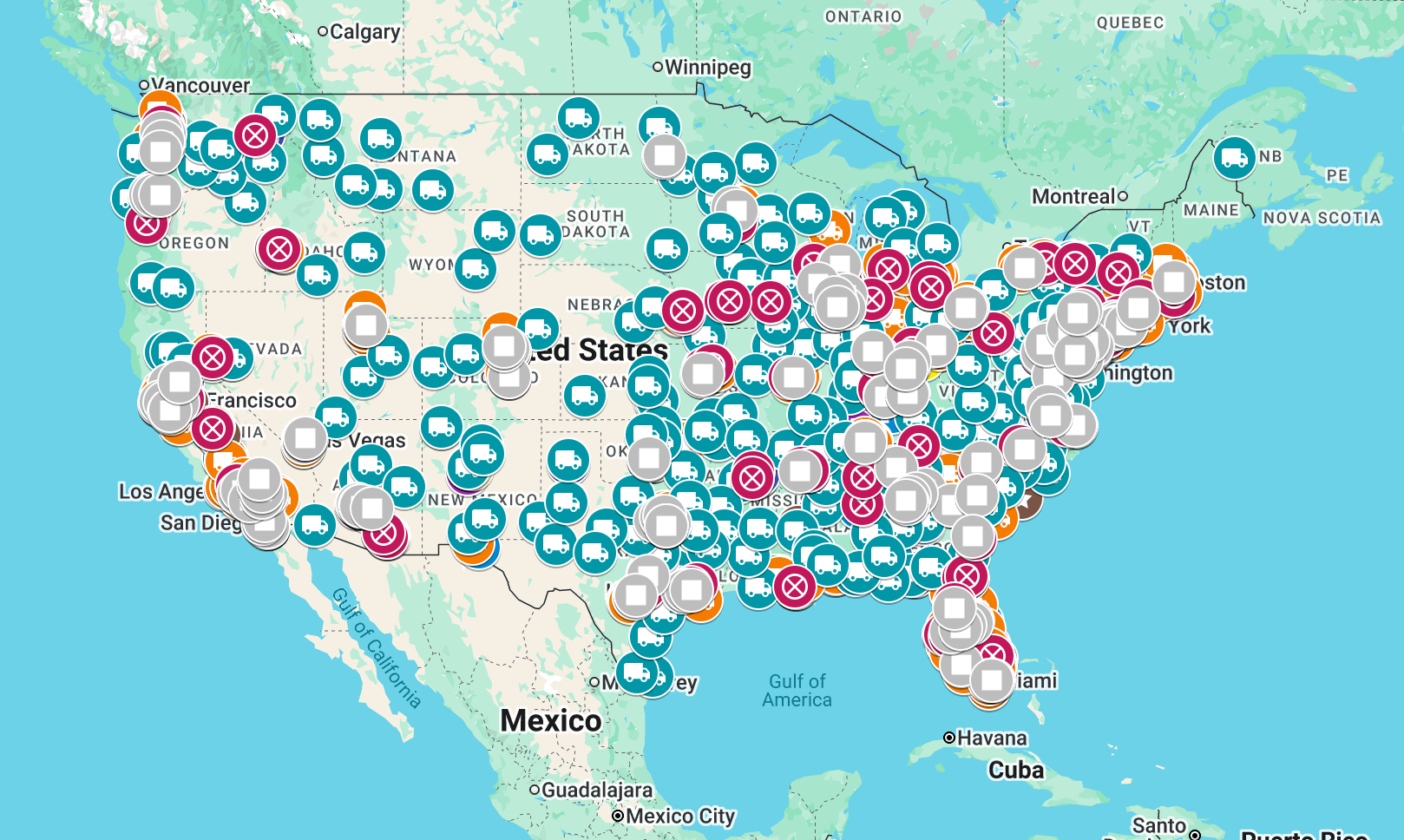
I’ve updated my Amazon distribution network map in preparation to write a new primer. I sort of dropped the ball last time I did this data update work and only completed a part one of the primer, but I promise to finish the whole thing this time. This is part of my “brief primers” series, but the Amazon one is getting so long now that “brief” is no longer an adequate descriptor. In any event, it should be out in the coming weeks.
The last time I updated the map was about a year ago, so I thought it made sense to compare the new data to last year’s, to see how Amazon’s distribution network has evolved. Here are the facility counts in the map:
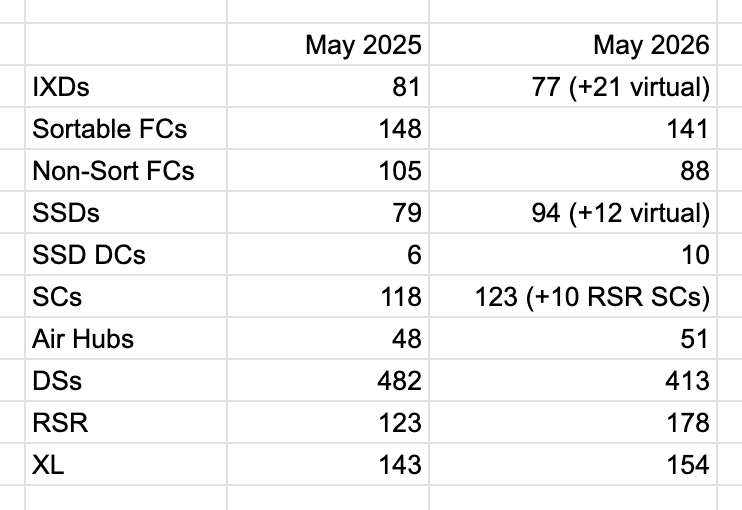
I’ve tried to contextualize some of the differences here in a way that can only be fully explained once that primer comes out, but some of the noticeable differences can be explained away as less significant than they might appear. As an example, there are now technically 98 Inbound Cross-Docks in the new map (as compared to 81 last year), but 21 of those are virtual nodes in larger facilities. So I don’t think the IXD network really expanded in terms of square footage.
But there are some meaningful changes here, most notably that the number of Delivery Stations (482→413 facilities) and Non-Sort Fulfillment Centers (105→88) shrunk, while the Rural-Super Rural (123→178) and Sub-Same Day Center (79→94) networks expanded. I don’t have a good explanation for the shrinkage of Non-Sort FCs. These are not, for the most part, very automated operations, but maybe they’ve figured out some efficiency there.
I devoted a whole column recently to Sub-Same Days, and there’s a chunk of my most recent column devoted to Rural-Super Rural. There are very different reasons for the growth of these segments: one to be able to do faster delivery in urban areas for high-volume SKUs, and the other to acquire rural coverage to wean off USPS. It’s not quite that simple, as I go into in the columns, but that’s how I’d describe it in a sentence. I assume the shrinkage in the Delivery Station network is mostly an effect of the RSR and SSD buildout. Both of these are alternate points from which packages are delivered; if they’re growing, Amazon doesn’t need quite as many Delivery Stations.
Again, primer coming soon!
Hi Ben - would love your thoughts on the new Amazon supply chain services segment that AMZN have been working on - in my head, it's a segment that should ahve higher margins than retail, while also bringing down retail cost to serve due to better utilization .