

How many Amazon Flex Drivers are there?
A rough estimate based on counting cars
Like other parcel giants, Amazon is known for its delivery vans - branded with Amazon logos and slogans but operated by their Delivery Service Provider subcontractors. In 2022, Amazon claimed there were 275,000 DSP drivers across 3,000 DSPS. More recently, they cited the creation of 390,000 DSP drivers and 4,400 DSPs since 2018. Some have taken those to be current numbers, but I think that's all the drivers/DSPs since 2018, some of which aren't currently working for Amazon. Average DSP size according to 2024 OSHA ITA data is 88. Multiply that by the 2909 DSPs listed here, and that's 255,992 drivers, and in the range of the company's 2022 claim.
Organizing efforts to date have targeted Delivery Stations, both warehouse associates and DSP drivers, for understandable reasons: the last-mile of a package's journey is by far its most expensive leg, and it's the one most resistant to automation efforts. Amazon has been trotting out drone delivery pilots, humanoid robot delivery assistants, and other last-mile tech fixes that gets the business press salivating, but I don't think we are anywhere near the implementation of anything that would substantially change up their last-mile strategy, i.e., paying human beings as little as possible to deliver their packages. The large warehouse automation efforts are a different story.
Delivery Stations are also in or close to urban areas, and you tend to get more organizing interest there. In addition, there are already organized delivery driver workforces at USPS and UPS, and so it's possible to leverage that density. Combine all this with the NLRB's joint employer decisions, essentially saying that Amazon so structures the work of DSP employees that they can be considered their “joint employer,” and focusing on Delivery Stations makes a lot of sense.
Unfortunately for the last-mile strategy in the United States, there is a large, precarious gig workforce of Flex drivers that also deliver packages. Flex drivers work by the block: an average one might be for 3.5 hours, during which time a driver might be expected to deliver about 40 packages from their own vehicle. Recently they’ve started doing express and rapid deliveries, and this has resulted in the proliferation of one-hour blocks, during which time a driver will deliver only 1-2 packages. Flex drivers sign up for these blocks on the Flex app; think Uber for packages.
Flex is a problem for organizing Amazon Delivery Stations for a number of reasons: if you're strategic and capable enough to get to the point of disrupting Amazon Logistics, they'll substantially increase the number of Flex blocks, in addition to just dumping more packages into USPS and UPS streams. If Amazon can quickly up their last-mile capacity outside of the DSP network by offering more and better compensated Flex blocks, it's pretty hard to materially impact the company through Delivery Station disruption.
For its importance to the company, however, it's very difficult to get a sense of just how big the Flex workforce is. Amazon claims that 2.9 million people have downloaded the app, but that certainly doesn't tell you how many people are actually driving for Flex.
From what I can tell, Flex drivers will pick up from one of five nodes in Amazon's distribution network: Delivery Stations, Sub-Same Day Fulfillment Centers (SSDs), Grocery Fulfillment Centers (GFCs), Whole Foods, and Rural-Super Rural (RSR) facilities. To my knowledge, Flex drivers exclusively handle deliveries at SSDs, GFCs, and Whole Foods. Both DSPs and Flex drivers serve Delivery Stations and RSRs.
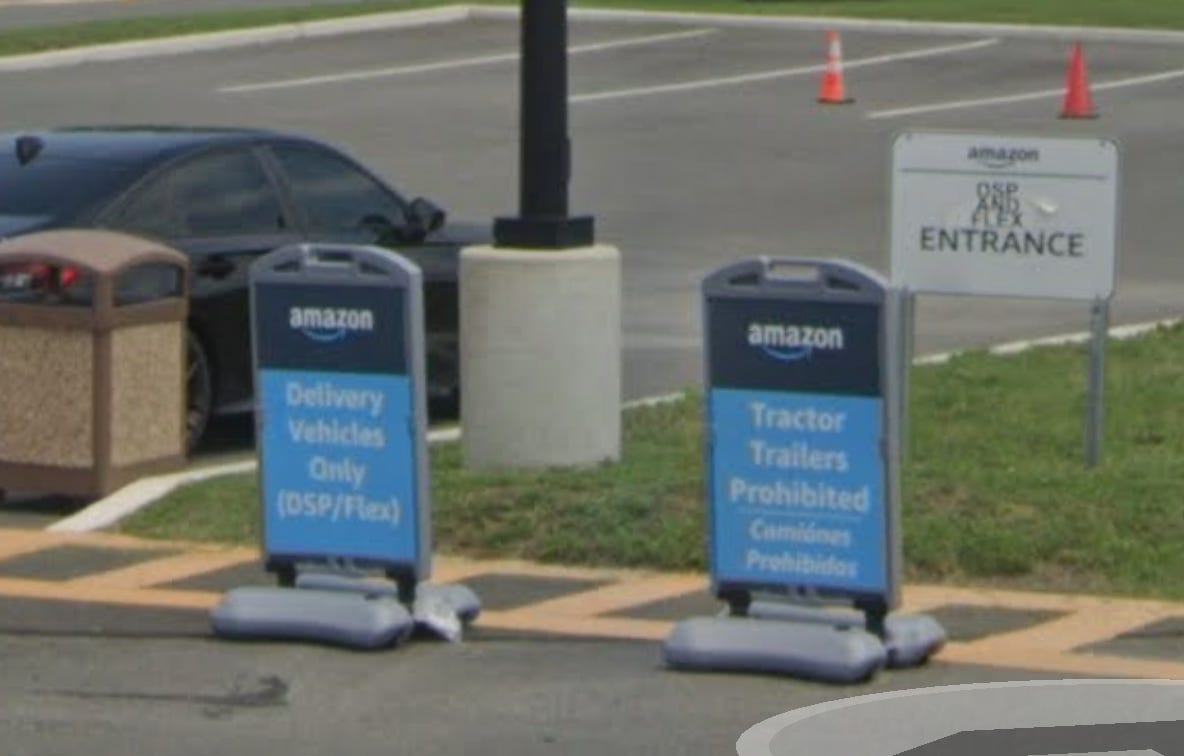
I couldn’t come up with a better method for estimating the size of the Flex workforce than going to some of these facilities, counting cars, and then generalizing based on what we know of Amazon’s distribution network. As an example, there are 79 Sub-Same Day (SSD) Fulfillment Centers in the United States. They're on average 189,000 square feet in size, and employ on average about 400 warehouse associates. Flex blocks at SSDs typically start in the 3am range, and the last ones start around 8pm, meaning Flex Drivers arrive at the facility throughout the day for about 17 hours, but clustered around CPTs, or “critical pull times.”
If I visited a representative SSD (but stayed off property) and got an average hourly inbound Flex car count, I could multiply that by 17 hours to get an average daily count, then by 7 to get an average weekly count. Flex drivers are capped at 40 hours a week, so at 3.5 hours, that’s a max of 11 blocks/driver. So if I then divided the weekly car count by 11, I’d get the rough number of full-time Flex drivers operating out of that SSD. Flex drivers tend not to work that many blocks (from Reddit, it seems like somewhere in the 20-25 hour range is about average), but I figured it made sense to estimate full-time (or 11 block) Flex drivers, not knowing how exactly to account for gig work variability and wanting a unit comparable to the DSP workforce. Multiply that by 79, and you get some sense of how big the Flex workforce operating out of SSDs is. Now repeat for Delivery Stations, Grocery Fulfillment Centers, Whole Foods, and RSRs - making sure always that the Flex driver delivery entrance/pick-up is differentiated from warehouse associate parking lots and any other spots in the facility where non-Flex driver cars enter.
Here’s what I found.
I observed two SSDs, each for about 7 hours. At one that was a bit above the average employee count, there were 100 inbound Flex cars per hour. At one that was an equal amount below the average employee count, there were 69. Averaging the two, that’s 84.5 cars/hour inbound at an average SSD. Doing the calculations above, you get: 84.5 Flex cars/hour x 17 hours/day x 7 days/week = 10055.5 cars/week. Divided by 11 blocks = 914.14 full-time Flex drivers per average SSD. And times 79 makes about 72,217 full-time Flex drivers servicing SSDs. (*Important Note: I did these observations before Amazon adopted express and rapid delivery options, so all of the cars that came on those days were for normal blocks.)
Delivery Stations are trickier, as there appears to be a bit of variety in how Flex operates in that world. For the most part, Delivery Stations will be all DSP pick-ups in the mornings, there will be a bit of a lull around lunchtime, and then Flex drivers will start to trickle in in the afternoon. At one Delivery Station that I observed, which was built recently and so has no OSHA ITA headcount data associated with it, there were 25.4 outbound Flex drivers/hour from 1pm-8pm. Before 1pm, it was all DSP vans, and after 8pm everything slowed to a trickle. 25.4 cars/hour x 7 hours/day x 7 days/week = 1244.6 cars/week. Divided by 11 blocks = 113.1 full-time Flex drivers per average Delivery Station (provided we’re taking that Delivery Station as representative). And times 479 Delivery Stations = 57,175 full-time Flex drivers servicing DSs.
However, after doing this observation, I realized there was an easier way to calculate Flex service provision at both Delivery Stations and RSR facilities. An anonymous source reported to me that the standalone SSDs handle about 2/3 of the same-day volume (the volume that Flex drivers handle), while Delivery Stations and RSR’s handle the other third. If that’s the case, then we can just halve the SSD estimate, and there would be 36,109 Flex drivers servicing both Delivery Stations and RSR facilities. That’s significantly less than the estimate I got from car counting, but I’m pretty sure the Delivery Station I observed had a particularly beefy operation and is not representative (also, in retrospect I realized that my particular vantage point at the Delivery Station did not allow me to distinguish Flex drivers from warehouse associates leaving). In any event, I’ll take my longer sampling of SSDs to be more more accurate and run with the Delivery Station/RSR estimate based upon that.
So now without counting GFCs/Whole Foods, we’ve got an estimated 108,326 full-time Flex drivers. Just food delivery left to count!
Both GFC and Whole Foods blocks are shorter, usually 2 hours or less rather than the 3+ that are typical at SSDs. This would make sense, as there are delivery window restrictions for perishables. I observed a GFC for three hours, and saw 12 Flex cars on average outbound. This was at a GFC that was a bit smaller than the typical GFC, employing 80% of the average employee count at GFCs (again, all according to OSHA data). So let’s say then that the average GFC is seeing 15 cars/hour. GFC drop off window start times usually go from 7am-8pm, so let’s say there are Flex drivers arriving continuously between 6am and 8pm. 15 cars/hour x 14 hours/day x 7 days/week = 1,470 cars/week. A full-time driver could do 20 shifts/week, so divided by 20 =73.5 drivers. Times 82 GFCs and that’s 6,027 Flex drivers working out of GFCs.
For the moment, I’m going to be lazy because I have sat on the street outside of facilities for a physically uncomfortable amount of time now, so I’ll say that each Whole Foods is seeing about half the volume as a GFC (without a dedicated fulfillment area, I’m not sure how they could do more than that). So 36.75 drivers x 550 Whole Foods = 20,213 Flex drivers working out of Whole Foods. Let’s just use that as a placeholder for now. And we arrive at the grand total of 134,556 Flex drivers in the United States (72,217 SSD, 36,109 DS/RSR, 6,027 GFC, 20,213 Whole Foods).
That’s again an estimate of full-time equivalent Flex drivers. If we take most Flex drivers to be driving an average of 25 hours a week rather than the limit of 40, then we might estimate that roughly 215,306 people are actually driving for Flex currently.
Whew! I’m going back to staring at spreadsheets now. But should I gain the courage to go back to the world of car counting, or should some noble insider have better information on which to base some of these estimates, I will update here.